
Last updated November 4, 2026
 Wrought iron
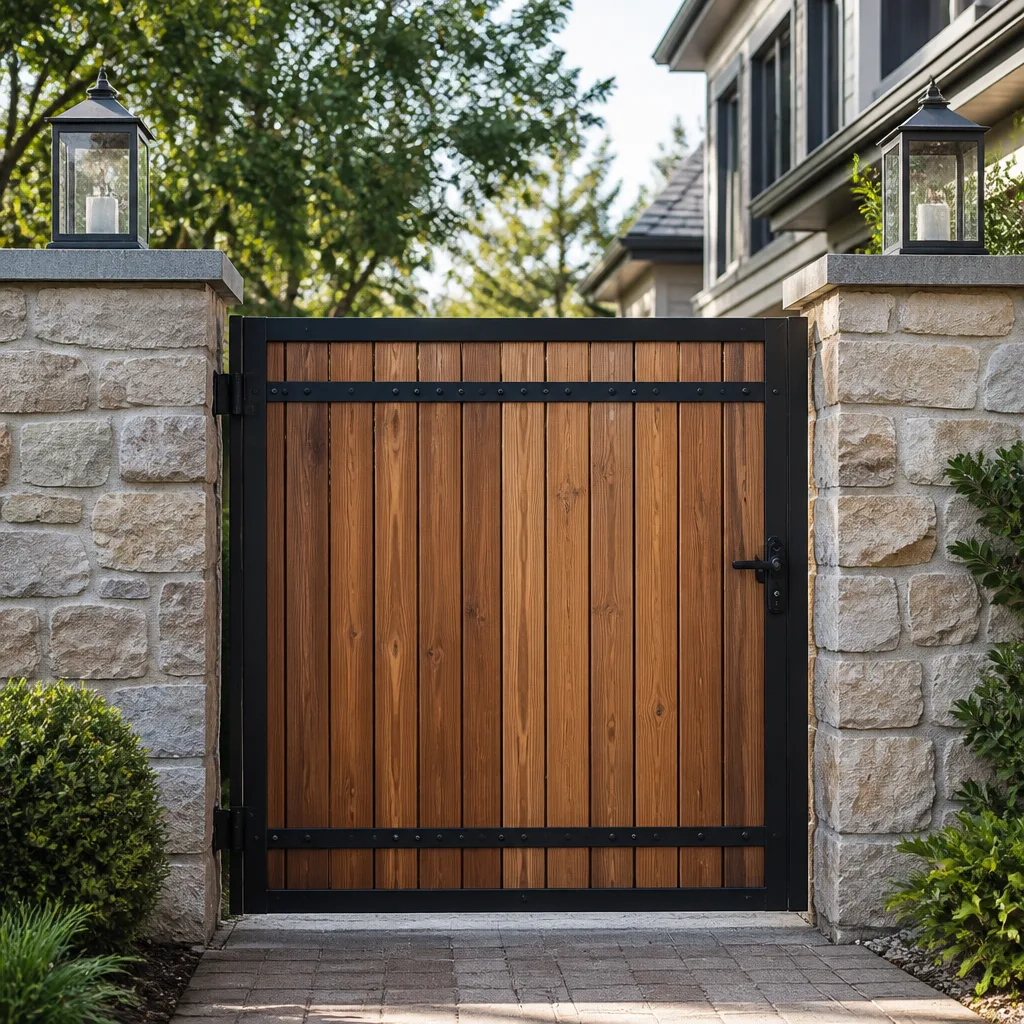 Wood & steel frame
 Farm & ranch
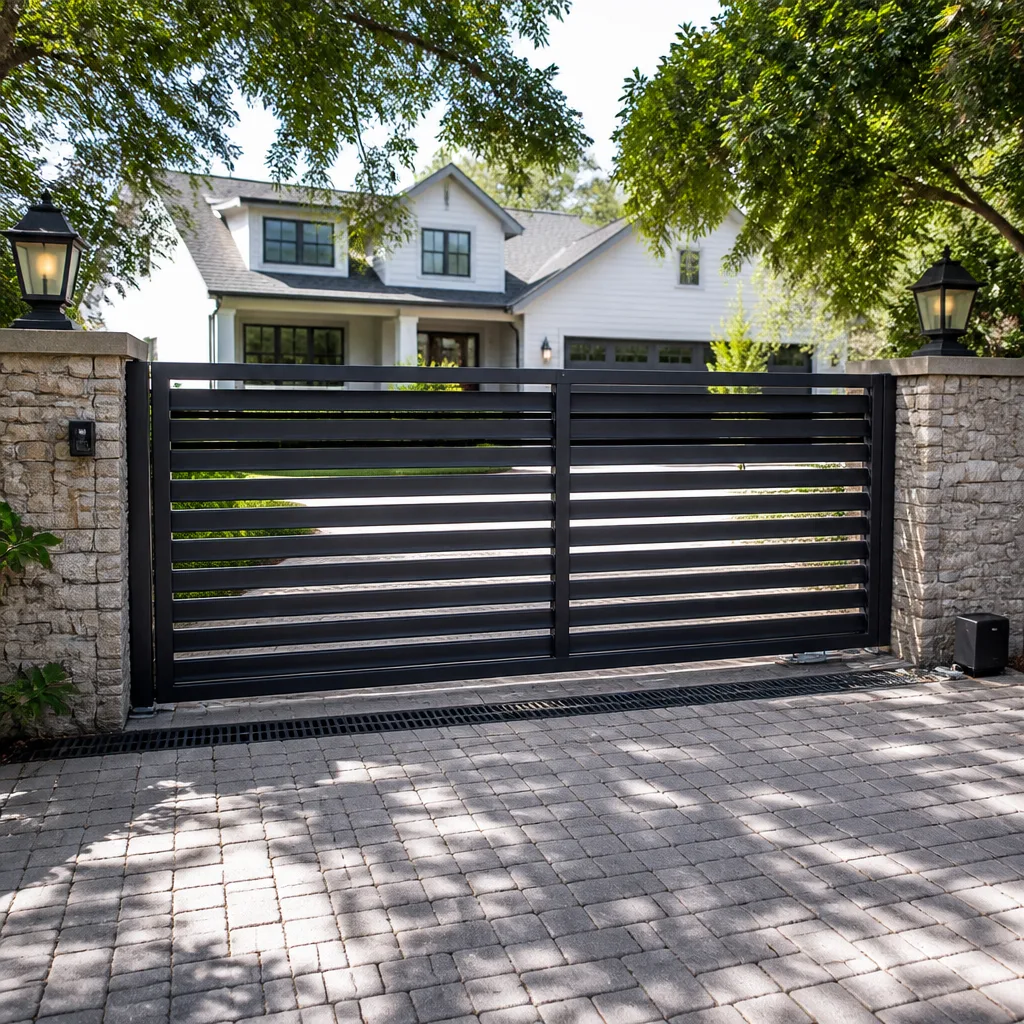 Sliding driveway gates
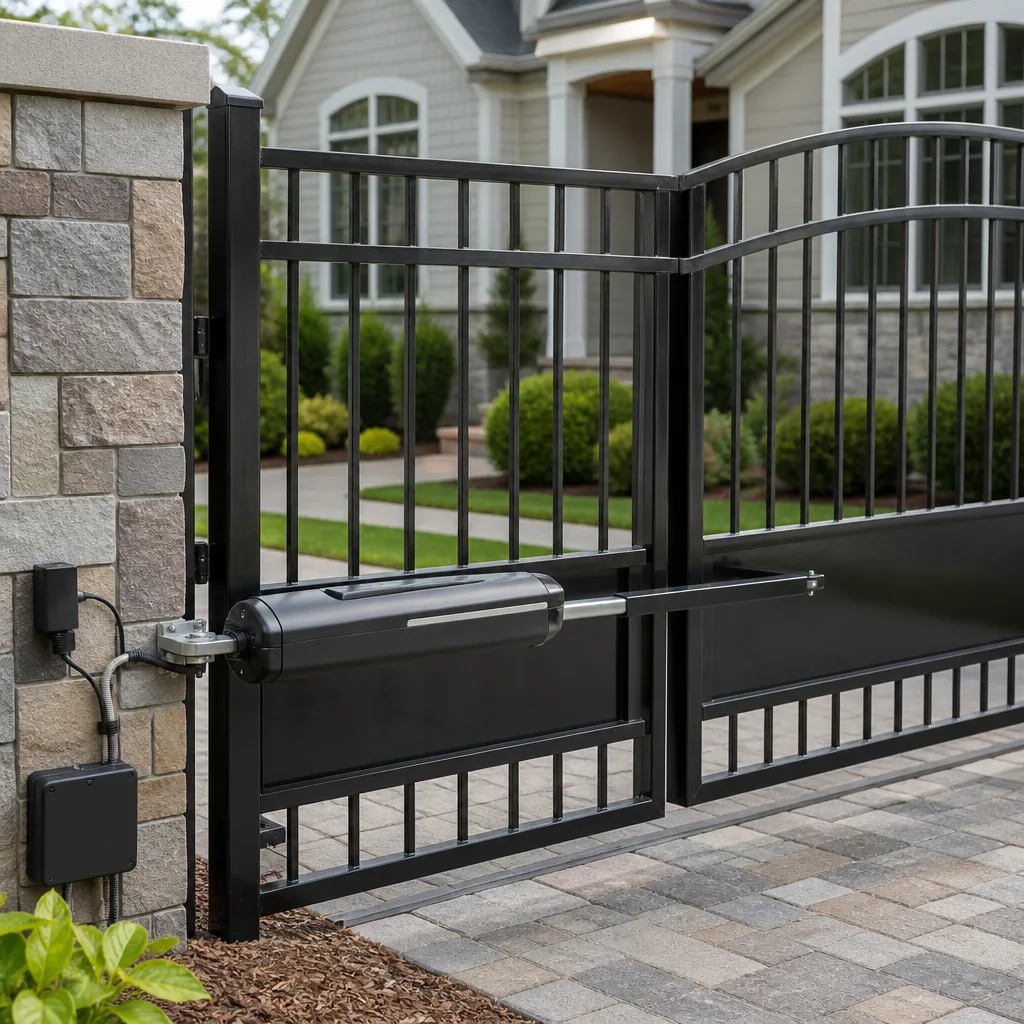 LiftMaster operators
Free on-site gate assessment - hinges, posts, and your LiftMaster or Nice gate operator checked before anything is quoted
The assessment is free and the quote is the invoice.
Get your free estimateGate Repair Warning Signs: A Laguna Niguel Homeowner’s Reference Guide
A grinding noise from a sliding gate is easy to assume is a track issue. In Laguna Niguel’s coastal environment, it’s just as often corrosion on the roller carriage – a completely different repair with different parts and different labor. The symptom is the same; the fix isn’t. This guide pairs each observable symptom with its statistically most likely cause so you stop chasing the wrong repair and start seeing the problem clearly. If you live in Laguna Niguel and your gate has started acting differently, this reference will help you understand what you’re looking at, what it likely means, and whether you can watch it or should act now.
Quick Answer
The most common gate repair warning signs in Laguna Niguel are slow or labored movement, grinding or scraping noises, a gate that reverses before fully closing, failure to latch securely, and partial opening. Each symptom points to a specific system – track, roller, operator, hinge, or sensor – and misreading one as another leads to wasted repairs. Our practical advice: if the symptom involves force, friction, or electricity, don’t wait. Call (855) 382-6561 for a free estimate from Prairie Gate Repair.
Styles & brands we work with
- Wrought iron
- Wood & steel frame
- Farm & ranch
- Sliding driveway gates
- LiftMaster operators
Table of Contents
- Slow or Labored Gate Operation
- Grinding, Scraping, and Squealing Noises
- A Gate That Reverses Before Closing
- Failure to Latch or Stay Closed
- Partial Opening or Stopping Mid-Travel
- Swing Gate vs. Sliding Gate: Different Problems, Different Warnings
- Electrical Warning Signs You Can Observe Safely
- Cosmetic Deterioration vs. Structural Failure
- Warning Signs That the Repair Window Is Closing
Slow or Labored Gate Operation
A gate that moves slower than it used to is the single most reported warning sign in gate repair. In our experience across Laguna Niguel driveways and commercial access points, slow operation is misattributed to a failing operator motor about half the time. That assumption sends homeowners toward replacing a component that still works while the actual problem gets worse.
The most common cause of slow operation on a sliding gate is friction on the track or roller carriage. Over time, dirt, decomposed granite, and fine dust from Laguna Niguel’s dry hills work their way into the rollers. The bearings bind. The gate still moves, but it takes more torque, and the operator strains against resistance it was never designed to overcome. On a swing gate, slow operation is usually a hinge problem – a sagging leaf, a corroded pin, or a post that has shifted out of plumb.
The second-most common cause is an operator that is genuinely wearing out. Limit switches drift. Capacitors age. A gearbox loses its smooth action. The symptom looks identical to track friction: the gate moves, just slowly, and often with a low hum.
Here’s the practical distinction. Push the gate manually (with the operator released, if you know how to do that safely). If the gate is hard to move by hand, the problem is mechanical – track, rollers, or hinges. If it moves freely by hand but labors under power, the problem is the operator or its power supply. That single diagnostic step saves Laguna Niguel homeowners hundreds of dollars in misdirected repairs.
Grinding, Scraping, and Squealing Noises
Noise is the warning sign homeowners notice fastest, and misinterpret most often. A grinding noise from a sliding gate reads as a track problem. In Laguna Niguel’s marine layer mornings and dry afternoons, it’s just as often corrosion on the roller carriage itself. The rollers are metal, the track is metal, and moisture sits on the lower rail overnight. What starts as surface oxidation becomes pitting, and pitted rollers grind no matter how clean the track is.
Here’s the symptom-to-cause map we use on every noise complaint:
- Grinding, metal-on-metal: Most likely roller bearings on a sliding gate, or hinge pins on a swing gate. Second most likely: a bent roller bracket dragging the wheel against the rail.
- Scraping, rhythmic, tied to gate position: Most likely a wheel that has worn flat on one side, or a gate leaf sagging just enough to contact the ground or the rail cover.
- Squealing, high-pitched, consistent: Most likely a dry bearing or a worn idler pulley. Second most likely: the operator’s drive belt slipping.
- Clunking at the start and stop of travel: Most likely a loose chain or drive belt, or worn limit stops. Second most likely: a broken roller allowing the gate to shift hard when direction changes.
The point here is that noise is rarely the track itself. Tracks are passive steel – they don’t make noise on their own. The noise comes from something moving against them. Finding that moving part is the whole job.
A Gate That Reverses Before Closing
An automated gate that reverses before reaching the closed position is doing what its safety system tells it to do. The question is whether the system is working correctly or seeing a problem that isn’t there. This is the most common electrical warning sign on electric gate repair calls in Laguna Niguel.
The most common cause is obstruction detection. Every automated gate uses either inherent pressure sensing in the operator (a force-sensing module that reverses when resistance spikes) or external safety edges and photo eye sensors. When these sensors read resistance that isn’t actually a person or vehicle – a stuck roller, a warped section of track, a hinge that binds at a certain angle – the gate reverses.
The second-most common cause on a sliding gate is a dirty or misaligned photo eye. Laguna Niguel’s dust doesn’t just settle on cars; it coats sensor lenses. A photo eye that thinks it sees an obstruction will command the gate to reverse every time.
A gate that reverses intermittently – sometimes it closes fully, sometimes it stops at 80% and backs off – is almost always a mechanical friction problem that trips the obstruction sensor. The sensor is doing its job. The real issue is whatever is causing the resistance spike at that position. Fix the friction, and the false reversals stop.
Failure to Latch or Stay Closed
A gate that won’t latch is a security problem, and in Laguna Niguel it’s also a liability problem. A gate that closes but doesn’t lock, or that drifts open over a few hours, reads as a latch failure. Often it’s a geometry failure.
On a swing gate, the most common cause is post movement. The post that carries the latch has shifted, usually because its footing wasn’t deep enough or because the gate leaf itself has sagged on its hinges. The latch bar no longer aligns with the strike plate. The gate looks closed, but the latch never engages. The fix is rarely a new latch – it’s re-hanging the leaf or resetting the post.
On a sliding gate, the equivalent failure is the gate stopping short of the receiver post. This is usually a limit switch issue. The operator thinks the gate has traveled far enough, but the gate is an inch short, the latch pin lands shy of the receiver, and the gate sits unlatched.
The second-most common cause across both configurations is a worn latch mechanism. Springs lose tension. Strike plates wear. The internal components of a magnetic lock fail. These are straightforward repairs once the alignment has been confirmed correct.
One more Laguna Niguel-specific note: coyote pressure. Gates on canyon-adjacent properties take more incidental contact. A gate that takes regular contact from an animal pushing against it – or a vehicle bumper in a tight driveway – will drift out of alignment faster than a gate that never gets touched. If your gate stopped latching, look first at the alignment, then at the hardware.
Partial Opening or Stopping Mid-Travel
A gate that opens partially and stops – or stops at random positions – is telling you something specific. This is different from slow operation and different from reversal. The gate starts, travels, and stops somewhere in the middle of its range.
The most common cause is a limit switch failure. Limit switches tell the operator where “open” and “closed” are. When a limit switch drifts or fails, the operator loses its reference point and stops wherever the signal drops out. On a professionally installed gate, this is a component replacement – not a major rebuild.
The second-most common cause is a power or control board problem. A board that’s getting intermittent power, or that has a failing relay, will command the motor to stop mid-cycle. This is more common on older operators and on gates that are used frequently – commercial access points in Laguna Niguel that cycle dozens of times daily wear out control components faster than a private driveway gate that cycles four times a day.
One important distinction: if the gate stops at the same position every time, suspect a mechanical obstruction or a bad section of track at that spot. If the gate stops at random positions, suspect the electrical control system. Random stopping is the pattern that points to the operator, not the gate itself.
Swing Gate vs. Sliding Gate: Different Problems, Different Warnings
Most generic gate advice treats all gates as the same machine. They’re not. A swing gate is a pivoting leaf on hinges. A sliding gate is a rolling panel on a track. The physics are different, the wear points are different, and the warning signs are different. We work on both configurations across Laguna Niguel, and we diagnose them differently from the first look.
Swing gate warning signs to watch:
- Sagging leaf: The gate drops at the latch end. The gap at the top hinge widens. This is hinge wear or post movement.
- Binding at one angle: The gate moves freely through most of its arc but sticks at a certain point. This is a bent hinge pin or a post that’s no longer vertical.
- Dragging at the latch end: The gate contacts the ground or the pavement as it closes. This is leaf sag, not a track problem – swing gates don’t have tracks.
- Operator arm knocking: A loud clunk when the operator starts or stops, especially with a piston-style operator. This is a worn clevis pin or a loose mounting bracket.
Sliding gate warning signs to watch:
- Wobble during travel: The gate shifts side to side as it moves. This is worn roller bearings or a bent roller bracket.
- Binding at one rail section: The gate moves smoothly except in one spot. This is a misaligned rail splice or a bent section of track.
- Jumping the track: The gate lifts off the rail or the roller comes off the wheel. This is severe – a broken roller, a badly bent bracket, or a damaged track. The gate can fall.
- Chain sag or belt slip: Visible slack in the drive chain, or a belt that slips and squeals. This is a tension problem or worn drive components.
The point is that a swing gate and a sliding gate don’t fail in the same ways. If you’re reading generic advice that doesn’t distinguish between the two, you’re reading advice that might send you to the wrong fix. When you call us for gate repair, the first question we ask is which configuration you have, because the diagnostic path splits right there.
Electrical Warning Signs You Can Observe Safely
You don’t need to open a control panel or touch a wire to read electrical warning signs on a gate. Most of them are visible or audible from the outside, and they’re specific. Here’s what to look for without ever removing a cover.
1. The operator hums but the gate doesn’t move. This is the classic capacitor failure. The motor receives power, tries to start, and can’t. The hum is the motor stalled. On older operators – FAAC and BFT systems especially – this is a capacitor replacement, and it’s a straightforward job.
2. The gate moves, but the lights on the keypad flicker. This is a power supply issue. The board isn’t getting stable voltage. It could be a failing transformer, a loose connection, or a battery backup that’s no longer holding charge. In Laguna Niguel, where most gate systems are tied to the home’s main panel, this is often a wiring problem at the junction box, not a control board failure.
3. The remote works intermittently. If you have to press the button twice, or the gate only opens from one remote but not another, the problem is the receiver or the remote itself, not the motor. Intermittent remote operation is one of the most misdiagnosed symptoms in gate repair – homeowners replace the operator when the fix is a new receiver board or a reprogrammed remote.
4. The gate opens but doesn’t close, or closes but doesn’t open, from one control source. If the keypad works but the remote doesn’t, that’s a receiver issue. If the remote works but the loop detector doesn’t, that’s a loop or detector problem. We see this on Linear and Viking systems in commercial applications in Laguna Niguel – the symptoms look like operator failure, but the operator is responding correctly to the inputs it’s actually receiving.
5. A burning smell near the operator. Electrical components don’t smell when they’re working correctly. A hot-component smell – like warm plastic or overheated wiring – is a genuine warning. Don’t keep operating the gate. Call us at (855) 382-6561. We answer 24/7.
None of these observations requires opening the operator housing or touching live components. The safe rule: if you can see it or hear it from outside the housing, you can diagnose it from outside the housing. If the problem is inside the panel, that’s our job.
Cosmetic Deterioration vs. Structural Failure
Laguna Niguel gates age differently depending on their material and exposure. A steel gate on a south-facing driveway in the sun and a wood gate on a shaded canyon lot will degrade in completely different ways. The skill is knowing which deterioration matters and which is just surface aging.
Cosmetic deterioration – watch, but don’t panic:
- Surface rust on steel: Orange staining or light pitting on the surface. In Laguna Niguel’s dry climate, surface rust progresses slowly. It can be cleaned, treated, and repainted.
- Sun-faded paint or powder coat: Chalky or dull finish. This is UV damage to the coating, not the metal underneath. It looks bad but doesn’t affect the gate’s function.
- Dry rot on decorative wood elements: Cracking at the ends of pickets or trim pieces. Cosmetic until it reaches the structural frame.
- Loose but present hardware: Screws that have backed out slightly, a handle that wiggles. Tightening is simple. Replacement isn’t urgent.
Structural deterioration – act now:
- Deep pitting or flaking rust on load-bearing members: If the metal is losing thickness, the gate is losing strength. Rust that flakes off in layers is structural, not cosmetic.
- Cracks at weld joints: A crack in a welded corner or at a hinge mount is a failure in progress. It will propagate. The gate will eventually fail at that point, and it’s heavier than you think when it lets go.
- Rot in the structural frame of a wood gate: If the posts or the main frame member is soft to the touch, the gate’s structure is compromised. A hinge screw that pulls out of a rotted post is how wood gates fall.
- Post lean or movement at the base: A post that has shifted is no longer carrying load correctly. The gate is stressing the wrong parts of the post footing and the hinge mounts.
The practical line: if the deterioration changes how the gate carries its own weight, it’s structural. If it only changes how the gate looks, it’s cosmetic. Don’t let a cosmetic problem scare you into replacing a gate that has years of service left. And don’t let a structural problem sit because it looks like surface issues. A gate that looks bad is an aesthetic choice. A gate that’s actually failing is a safety obligation.
Warning Signs That the Repair Window Is Closing
Some gate problems can wait a few weeks. Some can’t. The difference is whether the failure mode is progressive – whether the problem gets worse every cycle and whether the worsening damage spreads to other components. Here’s how to tell.
Repairs that become more expensive if deferred:
- A grinding roller carriage. Every cycle grinds metal off the roller. Eventually the roller seizes completely, and then the gate drags on the track. That damages the track, which means replacing track sections instead of just rollers.
- A sagging swing gate leaf. The hinge wear accelerates as the leaf drops further out of alignment. What starts as a hinge pin replacement becomes a hinge replacement, and then becomes a post reset and leaf re-hang.
- An operator run against a binding gate. The motor draws more current fighting friction. More current means more heat. More heat means shorter capacitor, board, and motor life. The friction problem is the original issue; the burned-out operator is the collateral damage.
- Intermittent electrical faults. A relay that sometimes fails is a relay that will eventually fail at the worst time – usually when the gate is open and can’t close. Intermittent problems don’t fix themselves; they lock in solid at the worst moment.
- Latch misalignment. An unlatched gate is a gate that can be pushed open. It’s also a gate that swings or slides freely in the wind, slamming and potentially damaging the hinges, track, or stop posts.
The pattern is consistent: the gate grinds away at itself every cycle. The longer it runs damaged, the more parts it damages. The repair that was one component becomes three components. The gate that needed a roller now needs rollers, a track section, and possibly an operator.
In our experience with gate repair across Laguna Niguel, the homeowners who call early spend less and get their gate back faster. The gate doesn’t care about your schedule. It wears on every cycle, whether you’re ready to fix it or not.
Common Mistakes to Avoid
- Lubricating a grinding gate instead of replacing the worn part. Grease quiets the symptom and accelerates the failure. The pitted roller is still pitted, and now it’s grinding grease and metal paste into the track. Lubrication is maintenance, not repair.
- Replacing the operator when the track is the problem. A new operator straining against a bound-up gate burns out faster than the old one. The gate was always the problem. The operator was the messenger.
- Ignoring a gate that reverses intermittently. A gate that sometimes reverses is a gate that will soon always reverse – or worse, a gate that will eventually stop reversing when it should and close on something. False reversals are annoying. Failed safety systems are dangerous.
- Assuming all gate brands fail the same way. We work on Ghost Controls and Mighty Mule residential operators, and on professional systems from BFT and Viking. Each brand has its own failure patterns and its own diagnostic logic. A symptom that’s common on one brand is rare on another. Generic advice misleads.
- Tightening screws as a fix for a sagging gate. If the gate is out of alignment, tightening the hinge screws doesn’t fix the geometry – it just makes the screws hold a bad position. The underlying cause is still there, and now the screws are over-torqued.
- Operating a gate with a partial electrical fault. A gate that hums, smells, or behaves erratically is telling you something. Continuing to cycle it while waiting for the repair spreads the damage from the electrical component to the mechanical system.
- Putting off the call because the gate still works. A gate that still opens and closes but shows warning signs is still wearing itself out on every cycle. The repair window doesn’t close when the gate stops working. It closes when the damage spreads to parts that were fine.
See the difference
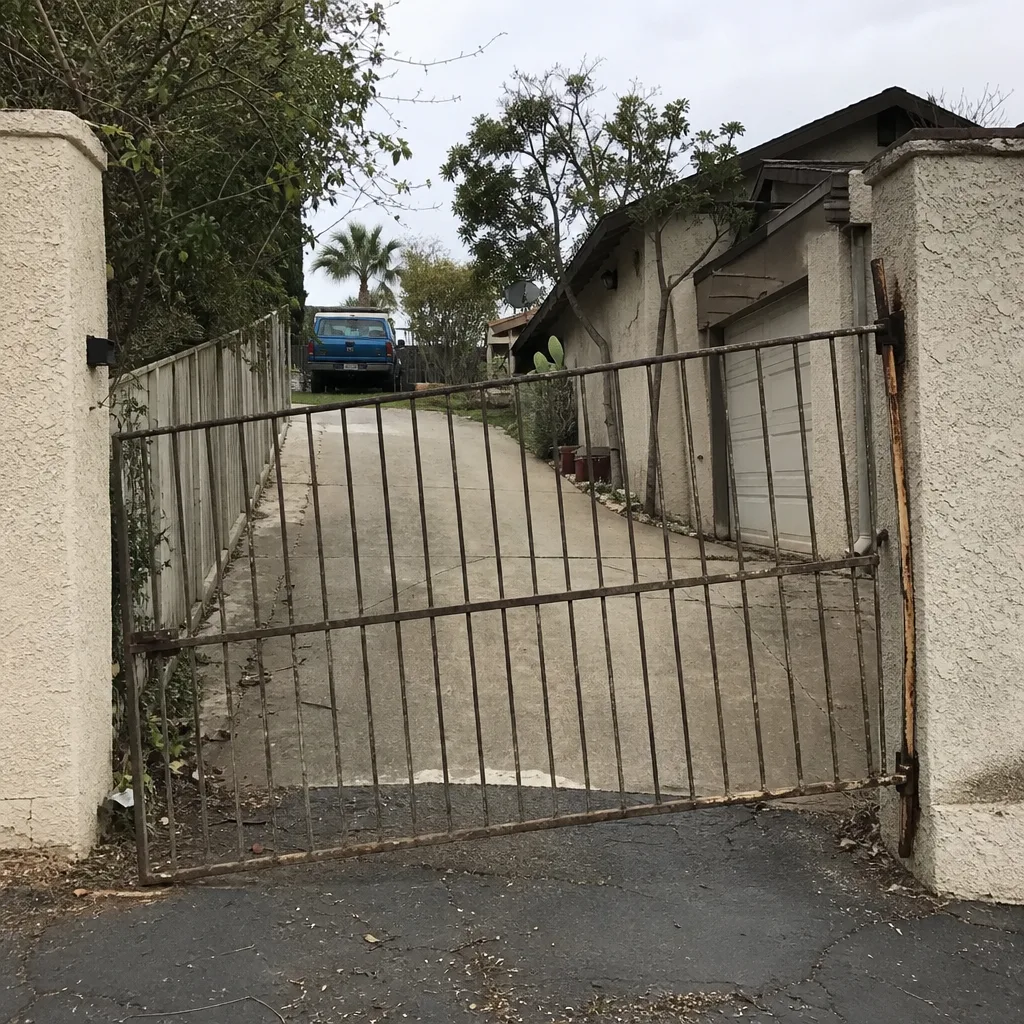 Before
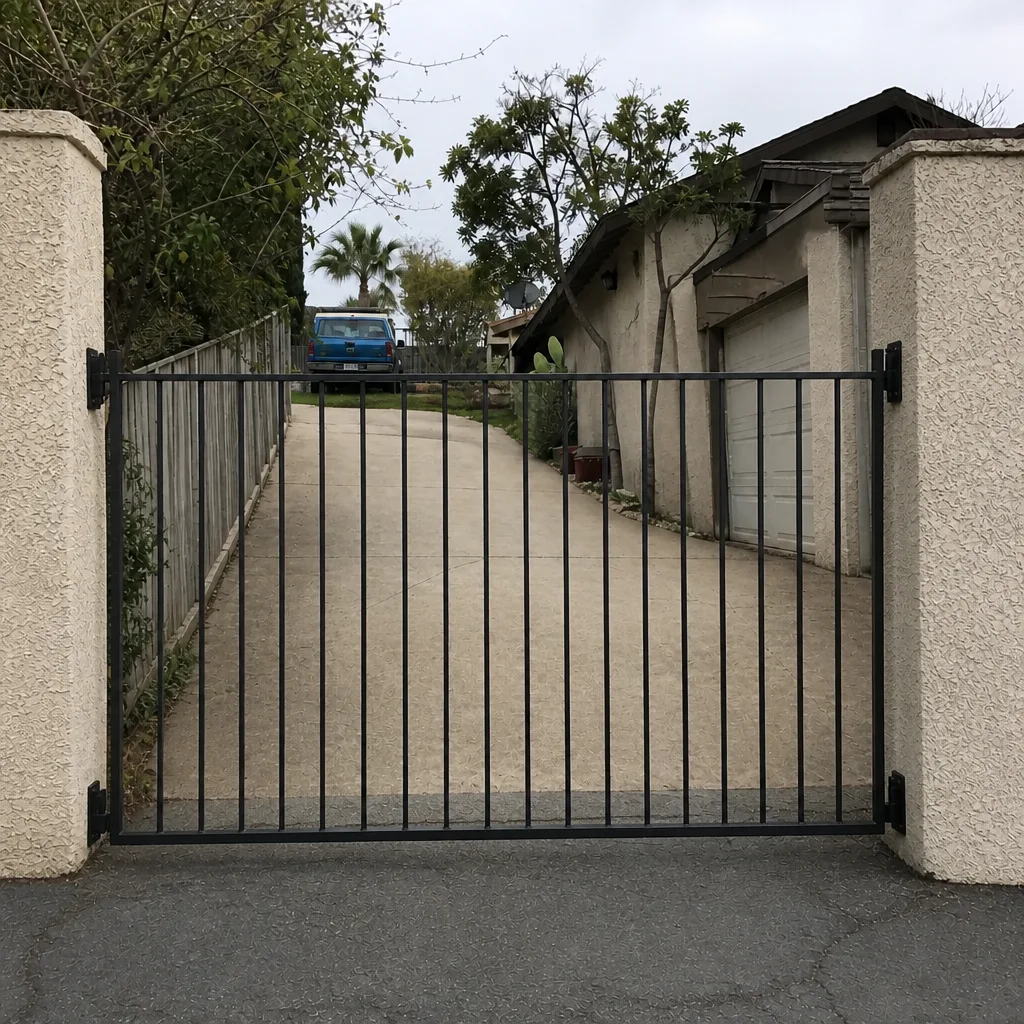 After
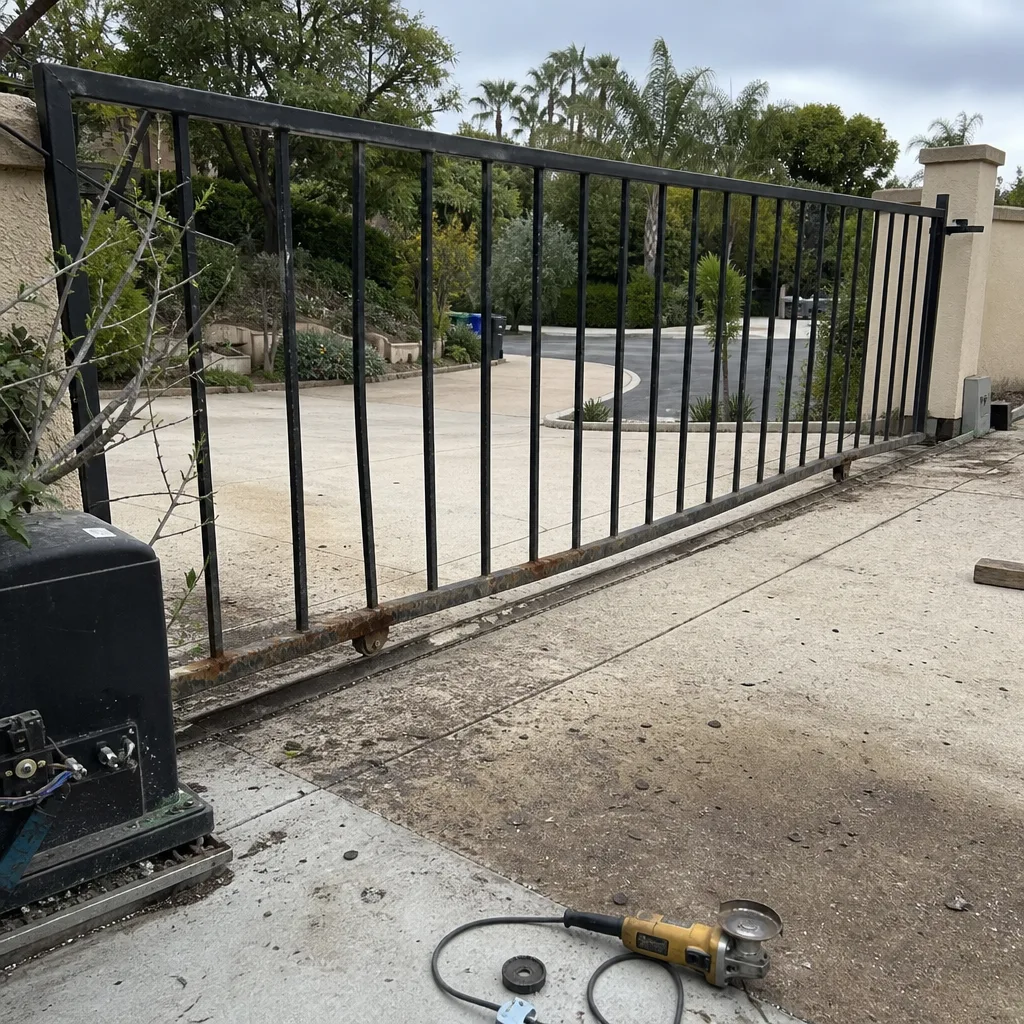 Before
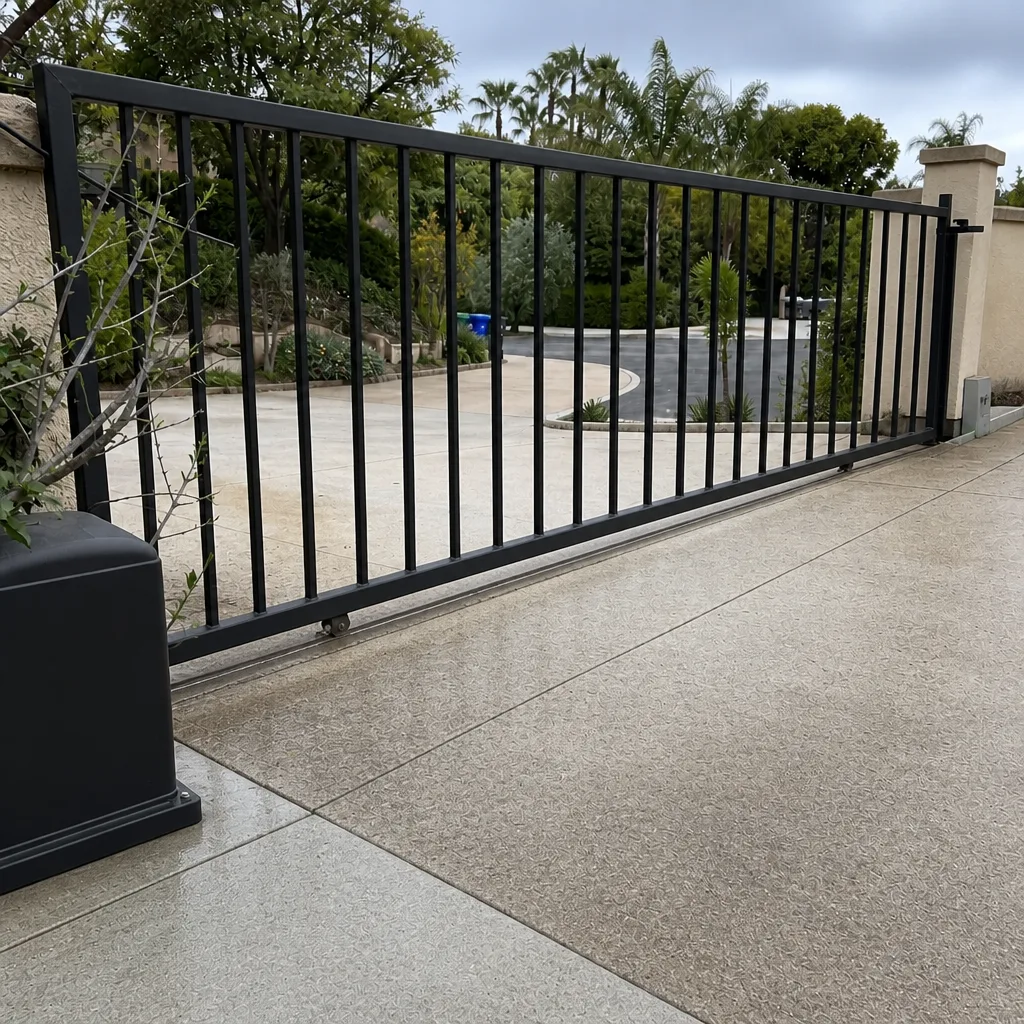 After
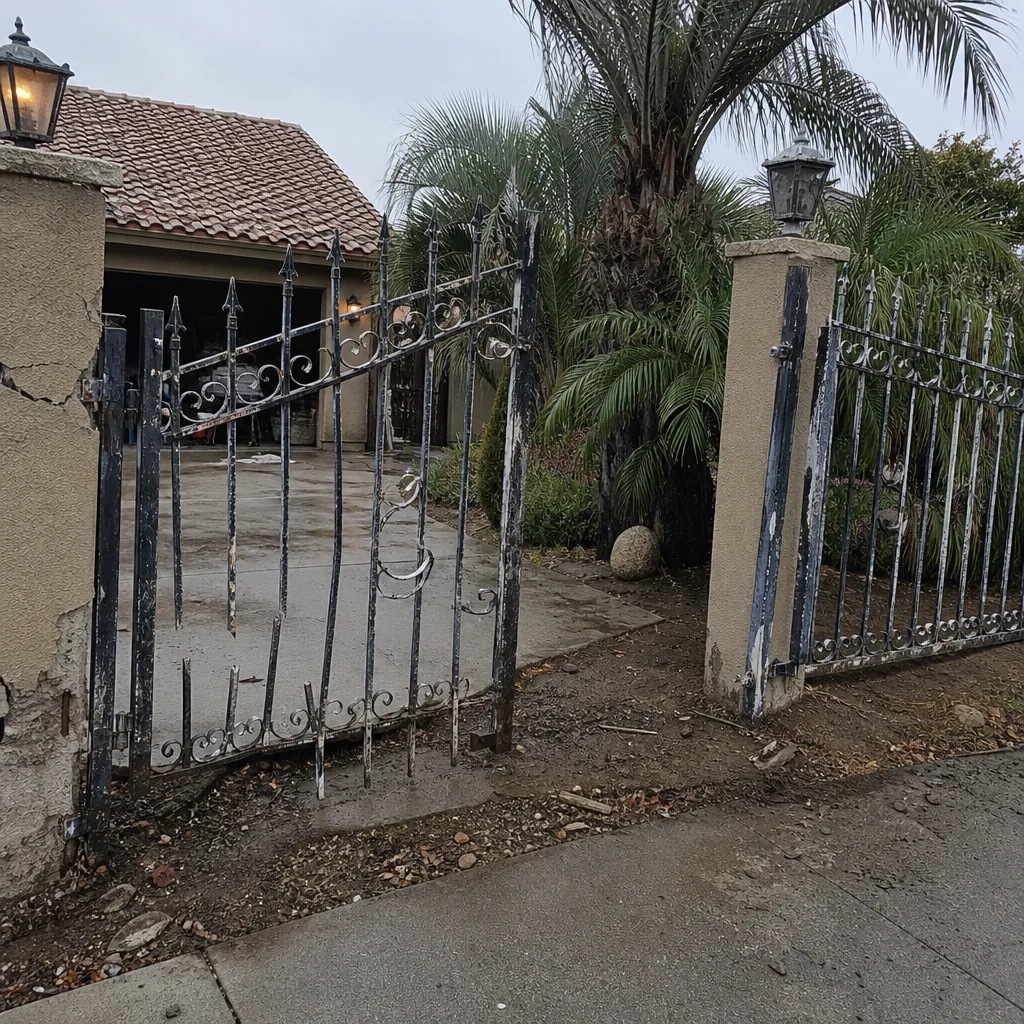 Before
 After
When to Call a Professional
Some gate observations are watch-and-wait situations. A little surface rust, a slightly faded finish, a remote that works nine times out of ten – these are maintenance notes, not emergencies. But there are moments when the right call is immediate.
Call a technician if your gate is grinding, if it’s binding at a specific point, if it’s reversing unpredictably, if it’s humming without moving, if you smell electrical heat, or if the gate has visibly dropped, sagged, or shifted. These are not watch-and-wait scenarios. They are the warning signs that precede a gate coming off its track, falling off a hinge, or an operator burning out completely.
Prairie Gate Repair offers free estimates in Laguna Niguel. We diagnose by the specific problem, not by a generic checklist. If your gate is telling you something, call (855) 382-6561. We answer 24/7. Fast dispatch from 7am to 7pm, Sunday through Friday.
Frequently Asked Questions
The most common gate repair warning signs are slow or labored movement, grinding or scraping noises, a gate that reverses before closing, failure to latch, and partial opening. Each points to a different system, and misreading the symptom leads to the wrong repair. If your gate is showing any of these in Laguna Niguel, call (855) 382-6561 for a free estimate.
Release the operator and push the gate manually. If it’s hard to move by hand, the problem is mechanical – track, rollers, or hinges. If it moves freely by hand but struggles under power, the problem is electrical – the operator, board, or power supply. This single test saves most homeowners from replacing the wrong component.
Yes. A gate that still works but grinds, binds, or labors is damaging itself on every cycle. The worn component is spreading damage to adjacent parts. The repair window closes when the damage expands, not when the gate finally stops working.
We work on residential and commercial systems from BFT, Linear, Viking, and Ghost Controls, among other major brands. Our diagnostic approach is brand-specific – each system has its own failure patterns, and we diagnose by the brand’s own design logic rather than guessing.
Every job is priced by the written estimate after we see the gate. There’s no flat rate that covers a worn roller and a burned-out control board. The estimate is free, the price is set before any work begins, and you’ll know the number before we start. Call (855) 382-6561 for an exact quote.
A gate stuck open is a security and liability problem, and we treat it as urgent. Call (855) 382-6561. We answer 24/7. Fast dispatch from 7am to 7pm, Sunday through Friday. If you call outside dispatch hours, we’ll book you into the next opening.
The Bottom Line
Gate warning signs are specific. A grinding noise isn’t always a track problem. A slow gate isn’t always an operator problem. A gate that won’t latch isn’t always a latch problem. The skill is matching the symptom to the system. In Laguna Niguel, our climate – marine layer mornings, dry dust, canyon coyote pressure – creates particular wear patterns that show up in specific ways on specific brands. If your gate is showing any of the signs in this guide, the cheapest moment to act is now. Every cycle wears the gate further, and the repair window narrows with each pass. Call (855) 382-6561 for a free estimate, and we’ll tell you exactly what your gate is saying.
Written by the team at Prairie Gate Repair, serving Laguna Niguel since 2013.